
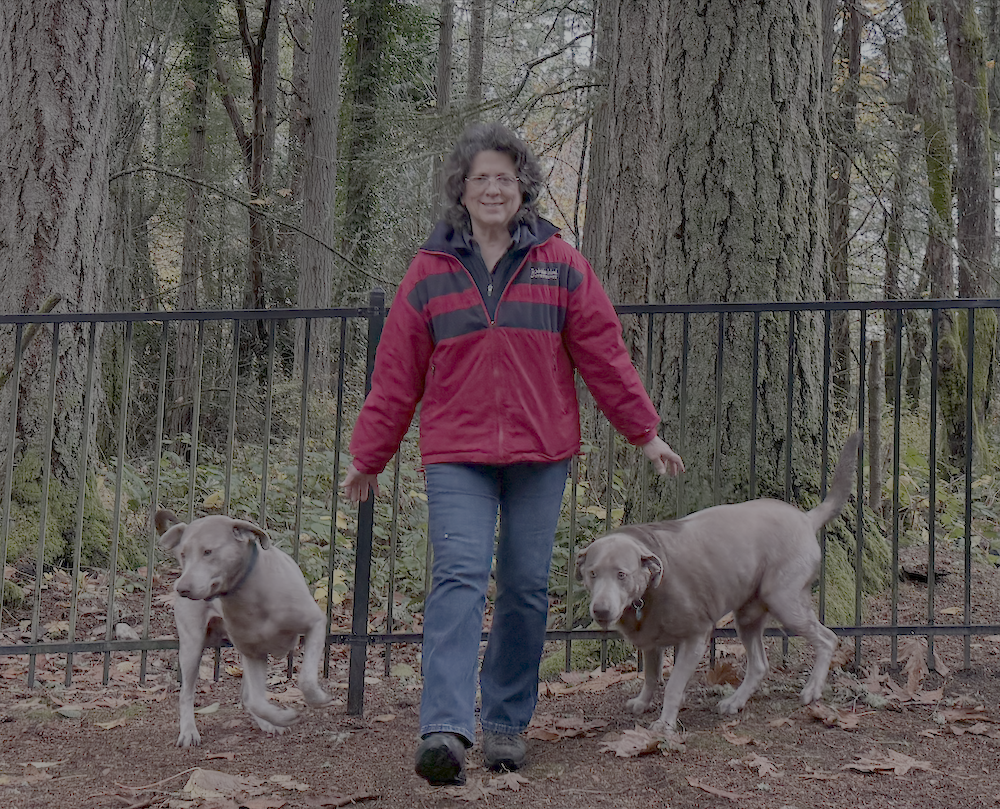
This is the second article in a series spotlighting members of the BP Team. We want to show you the passion and talent of our dedicated leaders. Today, we’re focusing on Dr. Susan Rausch who leads the Domestic Animal Care Team for Bainbridge Prepares.
Who are you and where are you from originally?
I am Susan Rausch. I am from the Midwest originally. We moved around for a few years to follow my Dad’s academic career, but after Dad finished, I basically grew up in California. I am married and I have two great dogs. I go by Sue or Susan.
Tell us about your education and previous work experience.
I completed a PhD from UCLA in Respiratory Physiology regarding the Control of Breathing in Man (studying the UCLA track team). I have an MD from UC Irvine. Then I completed an Internship, Residency, and Fellowship at Cedars Sinai in Los Angeles in Pulmonary/Critical Care/ Sleep Medicine.
After that, I moved to Scottsdale and worked in private practice for about 16 years as a critical care, pulmonary, and sleep medicine physician at the only Level 1 trauma center in Arizona. In 2010, I moved to Yakima as Medical Director of the Sleep Center at Yakima Memorial Hospital. I moved to Bainbridge Island in 2014 and worked at Virginia Mason Sleep Center until my retirement in 2025.
I have served on a number of medical committees, including Disaster Preparedness in Scottsdale in the era of biological warfare concerns in the early 2000’s. I have also been a Regional Speaker for a number of pharmaceutical companies. I would speak about the drug characteristics, indications, and administration and would answer questions to educate on general medicine (usually Sleep Medicine) topics.
How did you become interested in BP?
I initially joined BP during Covid as a member of the Medical Reserve Corps. I worked in testing and vaccination clinics for BP, with the National Guard, for Virginia Mason, and at Supervax events in Seattle.
How did you become interested in the Domestic Animal Care Team?
I have had a dog and/or cat for most of my life and have been concerned about their welfare and, by extension, the welfare of all animals—the dependent voiceless loving beings around us. I wanted to provide some sort of support to BI animals, so I joined the Domestic Animal Care Team and am now Team Lead.
We currently have two silver Labs. They are in the 80- to 90-pound range so we have at least 40 pounds or more of food always in reserve. We purchase a new food bag when the current reserve is opened so we are always renewing for freshness as well.
I am very grateful for the support from Stephen Richardson and Anne LeSage as well as other members of other BP teams—especially Becky Poppleton and Christina Aitchison who lead Map Your Neighborhood. The goodwill and hard work others put in make it easy to follow suit—there is clearly a caring effort to help each other be ready for a big lift in an emergency.
Tell us more about your team.
My team is small but mighty—I am so happy to have such motivated, creative, informed, hardworking, knowledgeable, and experienced team members: Kay Frichman, Dean Alexander, and Dave Sander. I also have three reserve volunteers and work with the two vet clinic directors on the island.
We would love to have more support—especially in time of disaster. Four active and five reserve volunteers are not enough. You can sign up to volunteer and then ask to be assigned to the Domestic Animal Care Team. I will then contact you.
We hope at some point to expand our services to those animals not considered domestic pets: livestock or outdoor animals. But we are too small now as a team. If you are interested, let me know and we will try to ramp up to care for/account for/coordinate for all animals on the Island.
We are very interested in recruiting or at least identifying those people who work with animals on the Island and who are familiar with scared or anxious animals. I’m thinking about people who work at vet clinics but also groomers, animal day care workers, pet sitters, and pet walkers. We need people after a disaster to help with strays and care for animals.
We are in the process of “mapping” our island for the domestic animals we have—there is currently no information about numbers or types of animals on the Island, which makes planning difficult.
What three key things do you want everyone to prepare for their animals?
Know that you will likely be caring for your pets in an emergency. Plan as if there is no one else to care for them; anyone else will certainly not know your pets as you do. Your presence will be comforting and you are in the best position to know what they need (not just in terms of food/water, but also regarding comforting contact, soothing words, and reassuring routines.
The number-one preparation supply is food and water—enough for 14 days (30 days if you can). Know what you need per animal—amounts are based on weight. We have a preparedness handout available that can spell that out for you, or you can look online. In times of stress, your animals will likely need more food.
If you have to evacuate, you need to take your animals with you. This means you need to have key supplies on hand: crate, bowls, cleaning supplies, food, water, leash, muzzle, harness (preferred over collar), lightweight cover for crate, interior crate blanket, your scent on an old shirt in the crate, toy, i.d. (pet name), your contact number, and a vet contact number.
Finally, make sure to keep a pet first aid kit on hand. We will be publishing a checklist o supplies soon.
What is your personal motto?
Be prepared, do what it takes, know what you need both to have and to do, and practice.
In medicine, we would practice so, when the need arose, we knew what to do, and it was familiar. The fear/shock/trauma in the moment did not interfere with what was needed. When I oversaw residents in training, I used the analogy of lap swimming when getting ready for the big race—practice makes the effort better when you’re called on to perform
What are your hobbies?
I love to garden—I can go out to work in my yard with my cares or concerns to mull over and return with solutions to/comfort for my problems
For my first job I was a talking Christmas Tree in a large mall. The magic of Christmas eclipsed the improbability of a Christmas Tree capable of thought and speech.
What is your favorite BP moment?
During Covid, as an MRC team member, during one of the first vaccination clinics (about 10 months into Covid), I turned to another doctor and said, “What is that sound?” I realized it was laughter—I had not heard a group of people together laughing in about a year! They were waiting the recommended 15 minutes after their shot to make sure that they were okay, and their relief was palpable.
A second closely tied memory was of patients’ physical approach to the vaccination chair. Often the person was an unvaccinated adult helping their elderly parent to the clinic. They had likely spent hours searching online to find an appointment for a parent. While waiting for their turn at the clinic, people would be worried that it would not happen, that we would run out of vaccines, or that for some other reason they would not get their vaccination. During their approach to the vaccine chair, they would drop their papers because their hands were shaking, they would speak too fast or not at all. I prepped the patient’s arm and administered the shot. Sometimes people would cry—from relief. I felt so privileged to be a physician in those moments, witness to the selfless love and gratitude people had for one another.