Disaster Hubs
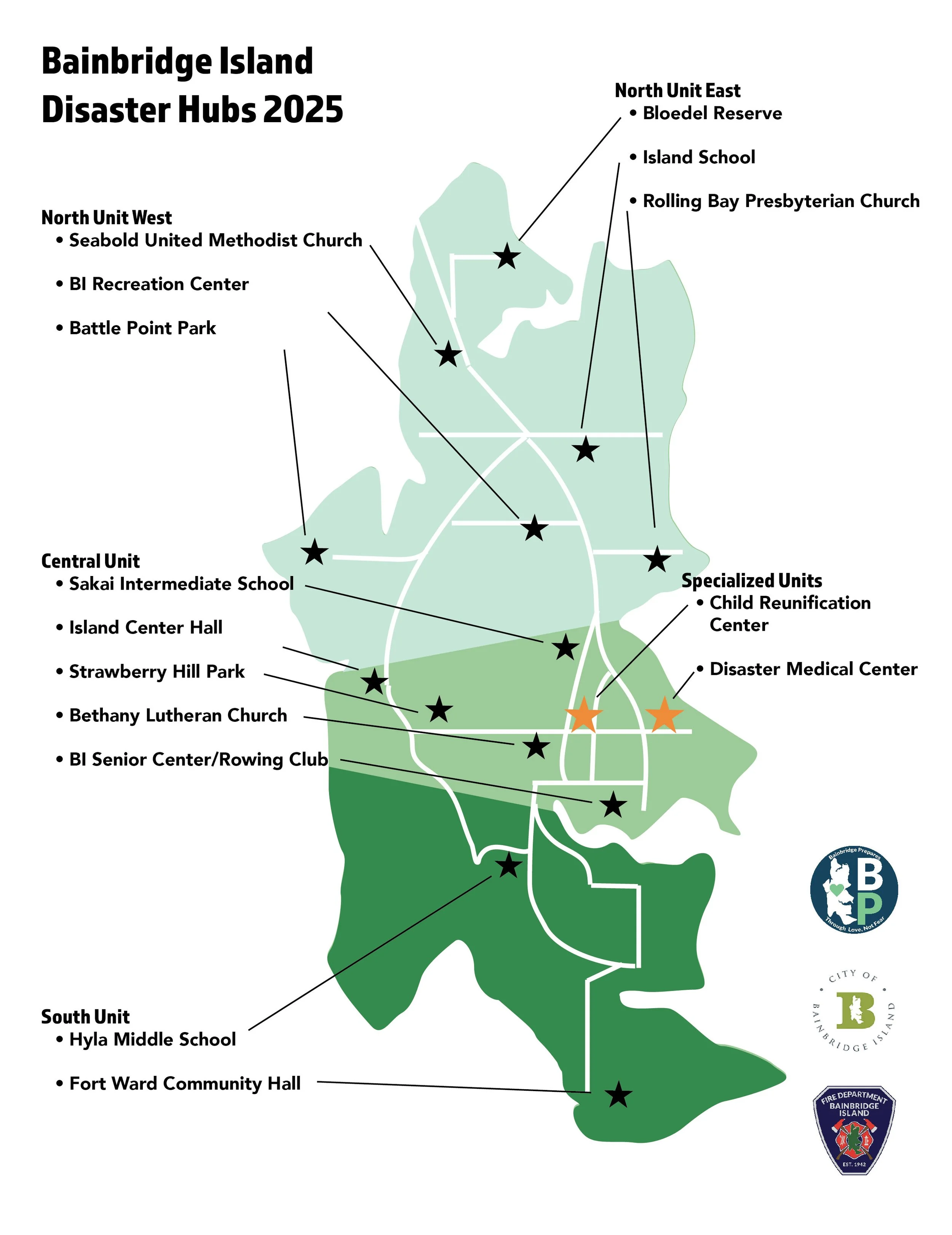
The Disaster Hubs program is a partnership between the community, Hub location owners, and the Bainbridge Prepares Partnership. A Hub is the focal meeting point for a group of neighborhoods to provide limited, gap-filling emergency services following a disaster. The Hubs are spread strategically across Bainbridge Island to be walking distance from our neighborhoods.
Hub services center around medical care and information sharing. Hubs will also provide limited shelter, limited food and water, and psychological care for those greatly affected by the event and unable to be cared for by their neighborhood.
The Disaster Hubs Team plays a crucial role in ensuring community resilience and self-sufficiency during significant disasters. Given the potential of Bainbridge Island to become isolated from Kitsap County and Seattle due to substantial earthquake damage, our Hubs serve as rallying points for community members and visitors alike.

Mission and Community Impact:
The Disaster Hubs Team serves a pivotal role in our community's disaster response infrastructure. By creating a network of emergency service points spread across the island, they ensure that vital resources and aid are readily accessible to community members during crises. This network enables a collective, localized response, allowing neighbors to aid each other when professional emergency responders might be overwhelmed or inaccessible. In doing so, the Disaster Hubs not only provide immediate care and assistance but also foster a strong sense of communal unity and resilience during challenging times.
About the Team:
The Disaster Hubs Team works in partnership with community members, Hub site owners, the City of Bainbridge Island, and Bainbridge Prepares to establish and operate these critical service points. These Hubs are staffed by dedicated volunteers, including members of the Bainbridge Island Medical Reserve Corps (MRC) for medical care and registered community volunteers for other needs. However, their effective functioning relies heavily on community preparation and volunteer commitment, with volunteers first ensuring the safety of their own homes and neighborhoods before activating the Hubs. As such, these Hubs may take anywhere from 24 hours to a few days to begin operating after a disaster, but once active, they serve as a vital lifeline for the community.
Hubs Team in action during the 2022 Cascadia Rising event.
First, a one minute overview from our leadership team…
Next, a three minute overview of our Disaster Hubs program…
And finally, a deeper 10-minute walk through of the specifics of our Disaster Hubs program.
Resources and Questions
-
The Disaster Hubs Team works on community preparation, establishing and maintaining hubs across the island, and recruiting and training volunteers. This preparation ensures that the hubs can become operational and provide support as soon as possible after a disaster.
-
During activation, the Disaster Hubs Teams will mobilizes the hubs to provide light emergency services, including medical care, information dissemination, limited shelter, food, water, and emotional support for those affected by the disaster.
-
The team is activated in the event of a significant disaster, such as a major earthquake, where the island might be isolated from the mainland and professional emergency services could be limited.
-
In the aftermath of a disaster, community members can seek help from the nearest Disaster Hub.
For non-emergency support requests, contact our Co-Leads. -
Medical: Medical Reserve Corps community members with at least a current Wilderness First Response certification (WFR) or higher medical license will stabilize and treat injuries. For injuries beyond their scope of practice, the patient will be stabilized and transported to a disaster medical center or hospital when available.
Information: Liaising with the City of Bainbridge Island’s Emergency Operations Center, the Hub will provide information about the status of the disaster, and information pertaining to it. It is also a central spot where neighborhoods can coordinate and share information to help each other.
Shelter: Hubs provide a temporary secure area for people to seek shelter. More than likely this means a space on the floor. This is intended for those, who through no fault of their own, have nowhere to go (i.e. people visiting or passing through the island, or their house was destroyed and they are waiting for another neighbor to take them in).
Hubs are about neighbors caring for neighbors. A Hub is as a place to where people can meet and help each other. It is not a place to rely on to go and have all your post disaster needs met.
Hubs will treat and release community members within 24-48 hrs, either transferred to a higher level of medical care, or reabsorbed into their neighborhood. -
The team needs a wide variety of volunteers, including medical professionals for care, community volunteers for other needs, and individuals who can help prepare their communities and assist in running the hubs.
-
Those interested in volunteering can contact our Co-Leads to learn more about the process and opportunities.
To Start, fill out the volunteer application available in the volunteer section.